How we feed our cats is as important as what we feed them
Cats Should Experience the Great Outdoors…Supervised!
Supervision outdoors = safety from and for wildlife
The average lifespan of unsupervised outdoor and indoor-outdoor cats is only 2-5 years, depending on where you live and sheer luck. The dangers of getting lost or hit by a car are at the forefront of most people’s minds, but how about wildlife? Wildlife is as dangerous to cats as cats are to wildlife. In fact, cats roaming outdoors, whether full-time or part-time, are the single biggest threat to urban bird populations, putting some species at risk for extinction. To learn more about the impact outdoor cats have on birds, visit www.catsandbirds.ca.
Wildlife is equally a major threat to the lifespans of cats, too. This is what you need to know:
Rodenticides take 2-3 days to kill their targets. If someone nearby is using it, an outdoor cat is also at risk. The odds of toxicosis in a cat from secondary ingestion are generally low, depending on the poison and the size of the rodent. But consider this: rodents that have ingested the bait become easy prey for outdoor cats who make 10 to 20 kills per day. Now those odds look quite a bit worse.
Direct and indirect disease and parasite transmission from wildlife to cats is common. The most obvious and deadly is rabies. Another is leptospirosis, a serious bacterial disease transmitted through the urine of infected animals. Pests and parasites transmitted through wildlife include roundworm, giardia, ticks, mites, and fleas. More information on parasites affecting cats is coming up.
When outdoors, cats are in danger of injury or consumption by other animals such as coyotes, foxes, raccoons, opossums and even squirrels (those guys are feisty!) As our urban communities continue to grow outward, wild animals are braving neighborhoods for survival, making seemingly safe areas more dangerous to cats.
Harness Training Tips
Harness training your cat is a fantastic way to bond with him and provide him with supervised outdoor exploration. It can be frustrating, though, when our cats don’t quite catch on as quickly as dogs do and many cat parents give up before really trying. Cats are smart – you know this! Whether 4 months old or, like Blue at 9 years old, cats can learn new things if we go about teaching them on their terms (cats: they own us).
Some tips from Blue’s Mom:
Find a harness that fits well and is comfortable yet secure enough that your cat won’t slip out of it.
- Let your cat get used to the harness just existing nearby. Don’t try to put it on him the first time he sees it.
- Wait for the right time to try the harness on your cat. If he’s sleeping, eating or stressed about something, he won’t have a positive experience with it going on. Try it when he’s awake, relaxed and has a good catnip buzz going on.
- Reward him with treats and head scratches when you put the harness on him the first few times. It will help to make the experience a positive one! If he doesn’t mind it, let him relax with it on to get extra comfy wearing it.
- Start walking with him inside your home and wait until he’s comfortable enough with the process before heading outdoors. Keep treats with you to entice him to move along with you and praise his good work with more treats. Blue’s Mom plans practice sessions around his meal time because he is so food-motivated and he will do anything to get that dish of deliciousness from her hand!
- If your cat isn’t ready to walk with you, be patient. Don’t give up and definitely don’t pull or drag him. Keep the whole experience a positive one and the two of you will be walking side by side soon!
(embed video of Susan Walking Blue on harness)
Catios
Catios are what they sound like, a cat patio. They are the ultimate way to let your cat freely experience the outdoors. They can be made in infinite shapes and sizes depending on your preferences, home and property. There is a misconception that catios are too expensive to purchase or too difficult to build. And what about rented homes or high-rise apartments? Where there’s a will there’s a way! Catios come pre-designed or custom-to-order and shipped in a format that is easy to assemble. If you want to save a few dollars, there are downloadable instructions on how to make your own (see Wallace’s Top Picks for this section).
Just imagine being able to open the window for your cat to run through a long tunnel into her own backyard paradise! Or opening your backdoor to a shared sanctuary where you can read a book next to your cat as she bathes in the warm sunlight. Have a small apartment in a high-rise with balcony access? If you’re lucky, your landlord may let you convert the whole balcony into a catio. Otherwise, something like a multi-level cage on wheels could do just the trick (and fold up for storage when your cat comes back inside). Our Content Editor, Lisa, uses the Amazon Basics Large 3-Tier Cat Cage (for balconies) so her cat, Smokey, can safely get some fresh air in Toronto. For safety, it’s easy to move so Smokey can go in before being wheeled to the balcony. When she’s all done, she wheels back in, gets out, and Lisa folds the catio up for easy storage.
Always Use Protection
Parasites are real buggers (pun intended)! Some of them even transmit other parasites – ugh! ‘For your and your cat’s health and safety, it’s important to protect both him and yourself (since some parasites are zoonotic, which means they can be transmitted from animals to humans).’
There are a variety of products on the market that are over-the-counter and prescription, and choosing the right one depends on where you live, the time of year, and your cat’s overall health. Indoor-only cats are as much at risk as indoor-outdoor cats because any of these
parasites can be brought into the home as easily as clinging to the human’s shoe or jacket or finding an opportunity to hop in when the door is left open. Mosquitoes, who carry a deadly parasite known as heartworm, are notorious for bothering us inside our homes!
Your veterinarian can guide you in choosing the best product to protect your cat. There are special considerations to be made for young kittens and seniors, as well as allergies and medical conditions. If your cat has already been exposed to a parasite, special lab testing may be required to determine the specific species and life stages present to successfully treat the problem. In some cases, there are consequential symptoms to treat as well, most commonly bacterial infections, diarrhea and dermatitis.
Calorie Counting
Calorie counting isn’t just for humans on diets. It’s important to every living creature on the planet to achieve and maintain optimal nourishment and health. Feeding your cat appropriate portions is the #1 way to prevent or treat obesity and all the other complications that come with it. Every bag and can of cat food should display its caloric content and using a gram scale to portion food is the most accurate way to get it right every time.
When determining your cat’s individual needs, your best resource is your cat’s veterinarian. If your cat is under or overweight, prioritize this issue and contact your vet’s office for a nutrition consultation. This service is generally complimentary if you bring your cat in for yearly check-ups and even more likely if you purchase your cat’s food from there.
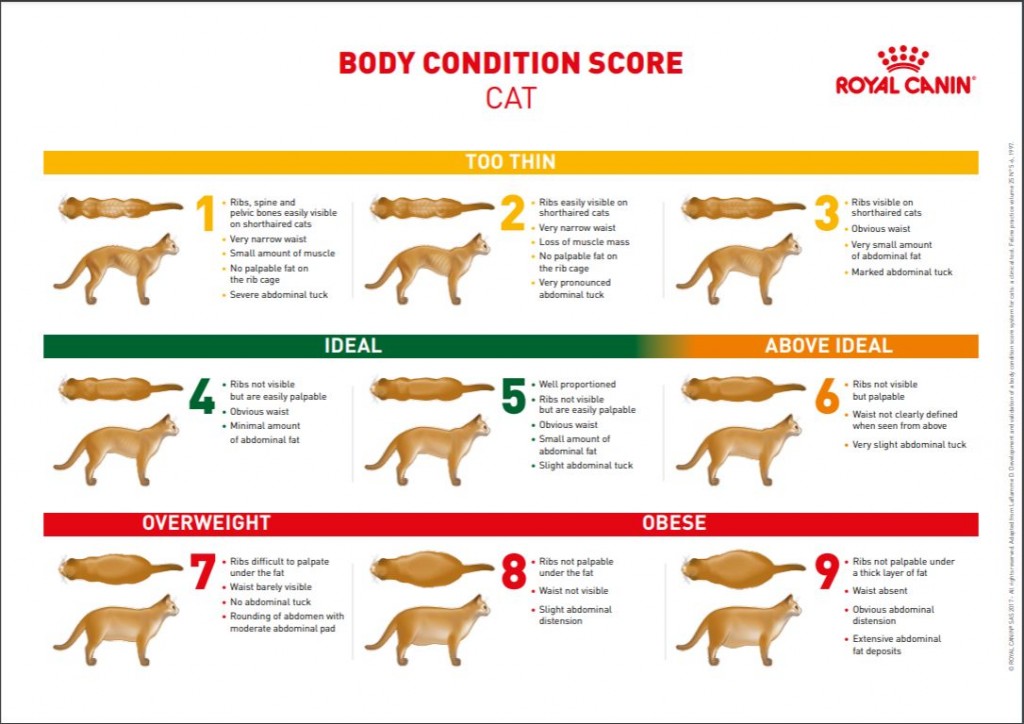
Did you know that more than half of domestic cats in North America are overweight or obese and yet most cat owners are unaware? The internet bombards us with images of chubby cats with the intention to make us laugh and smile – and it works! Chubby cats are adorable, but so are healthy cats. The problem is that we subconsciously associate larger cats with being more lovable and minimizing the importance of associating a healthy body condition score with a happier and healthier life.
What do we mean by body condition score (BCS)? It’s a tool to help us assess fat accumulation on an animal’s body and measure how much too much or too little your cat is carrying. It’s a better indicator of obesity than the scale alone and anybody can use it.
Puzzles Do Some Solving, Too
Your cat is smart. He’s likely a lot smarter than he’s given credit for. Does he ever look down at you from atop the bookcase with that demoralizing, “You know nothing” glare. Well, you can help him prove those smarty cat skills by putting his kibble in a puzzle. Beyond the problem solving fun, the puzzle feeder will help to:
- Slow down eating, thereby improving digestion of the food
- Provide stimulation and fun for much longer than it takes to eat from a dish
- Get your cat moving, which assists in weight management
- Reduce begging behaviour often associated with boredom
- Improve and maintain cognitive function as the cat ages
- Get really cute Instagram videos
- Cover our first point about banning the bowl
There are hundreds of feeding puzzles on the market and they can be very different from each other. Start your cat with simple puzzles so he can get used to the idea and find the process rewarding early on.Try a DIY puzzle if you’re hesitant to purchase one right away. Click here to see some of our own DIY ideas and here to watch Wallace work on some advanced dog puzzles!
There are hundreds of feeding puzzles on the market and they can be very different from each other. Start your cat with simple puzzles so he can get used to the idea and find the process rewarding early on.Try a DIY puzzle if you’re hesitant to purchase one right away. Click here to see some of our own DIY ideas and here to watch Wallace work on some advanced dog puzzles!
When There’s More Than One Mouth to Feed
Here’s a scenario many can relate to. You have three cats and one dog. Two cats are on a weight loss diet and you measure their portions carefully. A third cat is 17 years old; she eats a special age-appropriate diet and takes her time eating, sometimes leaving a little behind in her bowl. The first two cats are always starving and they race each other to finish their meals to get to the older cat’s leftovers; having an argument if they get there at the same time. Meanwhile, the dog is barking because she wants cat food, too!
Somehow, mealtime has become a stressful event for everyone. The overweight cats don’t seem to get along when they eat in the same room and they’re always competing against each other for the older one’s leftovers.The older cat is agitated by the barking and is anxious about the other two rushing over to argue over her dish. She rarely finishes her meals, despite being hungry, because she is too upset to stay long enough. Despite your best efforts to help, you’re also getting upset. The overweight cats aren’t slimming down and since the older one is losing weight, you’re worried she may be sick.. The dog, well, she will always be jealous of her feline superiors.